
Every parent eagerly waits for their child’s first word. It’s a big, exciting moment! But what happens when those words don’t come when you expect them, or when your child seems to miss talking milestones again and again?
It’s natural to feel a knot in your stomach and wonder: Is this normal? Am I worrying too much? When should I really be concerned?
You’re not alone with these worries. Delayed speech and language (DSL) means a child’s speech and language are not growing as fast as they should for their age. It’s a common concern for many families.
Understanding DSL is the first big step to getting the right help. This easy guide will show you the signs, what might cause it, and important steps you can take. Our goal is to give you the knowledge to spot the signs, find the right help, and empower your child to talk their best.
What exactly is Delayed Speech and Language?
At its simplest, DSL means a child isn’t reaching their speech and language growth steps at the usual speed.
It’s not about comparing your child to every other child. Instead, it’s about understanding a general timeline for how talking develops. While every child is special, there are clear guides that help experts know if a delay might be present.
Key Signs of DSL
The signs of DSL can show up in different ways. They might be subtle at first, then become clearer as your child grows. Knowing these signs can help you see when it might be time to ask for expert advice.
- Talking Late: This is often the clearest sign. Children with DSL might just not start talking when expected. Some children naturally start later, but if they consistently don’t make sounds or talk, it’s worth looking into.
- Small Word Bank: They might struggle to find the right words. Their total number of words might also seem much smaller compared to other kids their age. Imagine a child trying to say something big with only a few words – it’s frustrating for them and hard for you to understand.
- Trouble with Sentences: When they try to talk, children with DSL might find it hard to make sentences that are grammatically correct. Their speech might sound broken, or they might often put words in the wrong order.
- Struggle with Talking: This is a broader sign, covering problems with both expressing themselves and understanding others. They might have trouble saying what they need, want, or feel, which can lead to upset or pulling away. They might also find it hard to understand what others are saying, making simple instructions or chats difficult.
Noticing these signs is the first step in dealing with DSL. So, what causes these delays?
Decoding the Roots: What Causes Slow Language Growth?
Understanding why language growth delays happen is very important. The causes can be very different and often mix together. It’s rarely just one thing, but usually a mix of things that lead to a child’s talking problems.
Common Causes
- Growth Factors: Sometimes, it’s just that a child is growing at their own speed. Just as children walk and crawl at different times, their talking milestones can also vary. However, if delays keep happening beyond what’s expected, they should always be checked to rule out deeper problems.
- Hearing Loss: This is a key reason, but often not noticed. If hearing loss isn’t found or treated, it can greatly lead to DSL. If a child can’t hear sounds well, especially the small differences in speech, their ability to copy, make, and understand language will be greatly affected. Even mild hearing loss (common with frequent ear infections) can have an impact. This is why early hearing checks are so important.
- Brain Growth Problems: Conditions like Autism Spectrum Disorder (ASD) and ADHD (Attention-Deficit/Hyperactivity Disorder) can greatly affect how speech and language grow. In ASD, problems often show up in social talking or repetitive language. ADHD can affect focus, which is important for understanding and using language. Early diagnosis and help for these problems often include strong speech and language support.
- Surroundings: How much language a child is exposed to plays a huge role. Not enough constant talks, limited exposure to language (like not reading aloud often), or even too much screen time without talking and interaction can badly affect language growth. Children learn by hearing and interacting, and a poor environment can create big roadblocks. Giving many chances for language stimulation is super important.
While the causes might seem a bit much, finding them is the first step toward getting the right help.
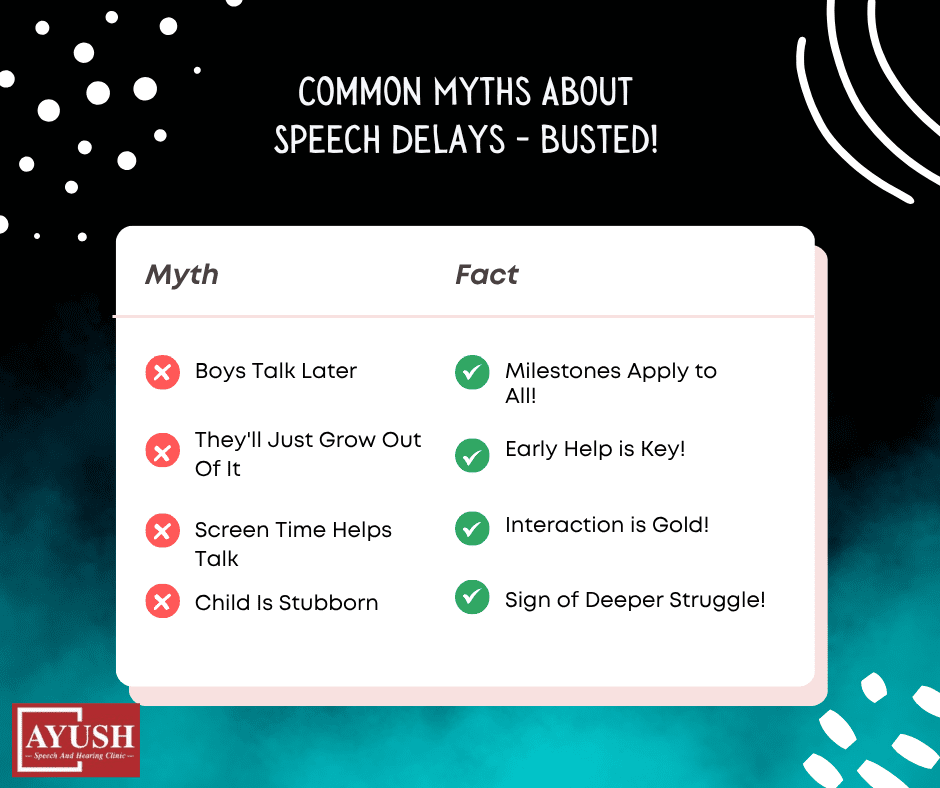
Common Myths About Speech Delays – Busted!
When you’re worried about your child’s speech, you might hear a lot of advice – some helpful, some not so much. Let’s clear up some common myths that can actually delay getting the right help.
-
Myth 1: “Boys just talk later than girls.”
- Fact: While there can be slight differences, significant delays in boys should not be dismissed. Both boys and girls should be reaching similar speech milestones. Don’t wait based on gender.
-
Myth 2: “They’ll grow out of it.”
- Fact: This is one of the most dangerous myths. While some children do catch up on their own, many don’t. Waiting can mean missing crucial windows for easy and effective intervention. Early help is almost always best.
-
Myth 3: “Screen time can help with language development.”
- Fact: Passive screen time (just watching videos) does not help language development and can even hinder it. Children learn language best through back-and-forth interaction with people. Educational apps can be used in moderation, but they are no substitute for human connection.
-
Myth 4: “My child is just stubborn, that’s why they don’t talk.”
- Fact: A child’s refusal to speak is almost always a sign of a deeper difficulty, not defiance. They might be struggling to understand or express themselves. Blaming stubbornness can delay crucial assessment.
Spotting the Milestones: When Speech is thought to be Delayed
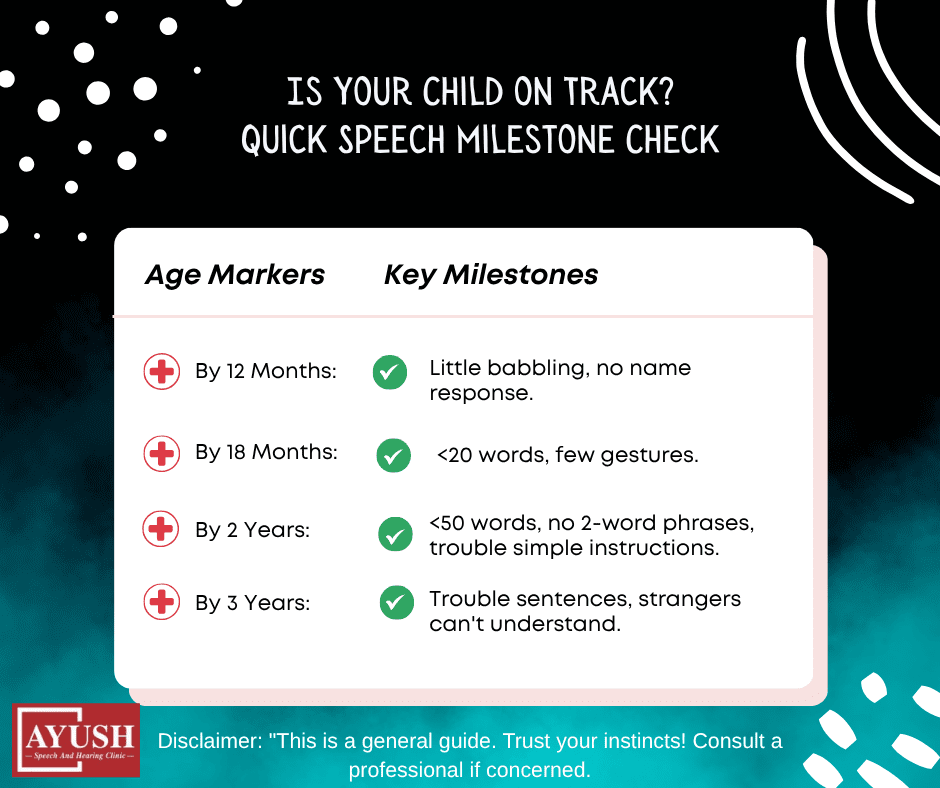
It’s normal for children to grow at their own speed. However, there are clear growth steps that show when speech might be considered delayed. Knowing these typical steps can help you tell the difference between a “late bloomer” and a situation needing expert help. This section gives a clear guide for how to spot a speech delay by age.
Age-Specific Milestones
-
By 12 Months:
- No babbling or very few sounds: Typical babies at this age are babbling with many different sounds (like “baba,” “mama,” “dada”).
- No reaction to sounds around them or to their names: This could mean hearing problems or problems understanding language.
-
By 18 Months:
- Few or no words: By this age, children should usually say about 10 to 20 words.
- Little interest in talking with gestures: While some gestures like waving or pointing are normal, a child with DSL might use these very little as other ways to communicate.
-
By 2 Years:
- Fewer than 50 words: This is a big warning sign.
- Not joining or putting words together into simple sentences or phrases: A child should usually be making two-word combos like “want toy” or “daddy go.”
- Trouble understanding simple instructions: If they consistently struggle with things like “come here” or “get the ball,” it could mean they have trouble understanding language.
-
By 3 Years:
- Trouble making simple sentences or phrases: They should be using short phrases (2-3 words) and have a vocabulary of 200 or more words.
- Most of the time, strangers can’t understand their speech: While parents understand a lot, strangers should be able to understand a good part of what a 3-year-old says.
If your child consistently misses these age-specific steps, it’s smart to talk to your child’s doctor. They can then send you to a speech-language pathologist for a full check-up.
Your Child’s Journey: A Quick Self-Check
Sometimes, a quick look can give you clarity. Use this simple checklist to consider your child’s communication at their age. If you notice several “Yes” answers, it’s a good idea to talk to a professional.
-
By 12 Months:
- Does your baby barely babble or make very few sounds?
- Do they often not respond to their name or other sounds around them?
-
By 18 Months:
- Do they use fewer than 10-20 words?
- Are they showing very little interest in pointing or waving to communicate?
-
By 2 Years:
- Do they use fewer than 50 words?
- Are they not combining words into simple phrases like “want toy” or “daddy go”?
- Do they struggle to understand simple instructions?
-
By 3 Years:
- Do they have trouble making simple sentences (2-3 words)?
- Is most of their speech hard for strangers to understand?
Remember, this is just a quick guide. Your intuition as a parent is incredibly powerful. If you feel something isn’t quite right, that feeling is valid and worth exploring further.
More than Just “Late Talking”: Understanding the Types of Speech Delay
While “delayed speech” is a common general term, there are several clear types of speech delay. Each type has its own signs and needs specific ways to help. Understanding these differences is key for getting the right treatment. This helps us in understanding expressive vs. receptive language delay.
Different Kinds of Delays
-
Expressive Language Delay:
This means trouble saying what they need, think, and feel. A child might understand what is being said to them but find it hard to make their own words or sentences to talk. They know what they want to say, but they can’t get it out.
-
Receptive Language Delay:
Here, the main problem is understanding spoken language. A child might struggle to follow instructions, understand stories, or process complex sentences. They might seem like they’re not reacting or are confused when talked to, not because they are ignoring you, but because they are genuinely struggling to understand the words.
-
Mixed Receptive-Expressive Language Delay:
As the name says, this means problems with both saying things and understanding language. This can be harder to deal with as it affects both sides of talking.
-
Speech Sound Disorder:
This isn’t exactly a language delay, but rather trouble making specific sounds or groups of sounds. A child might often swap sounds (like “wabbit” for “rabbit”) or leave out sounds, making their speech hard to understand.
-
Childhood Apraxia of Speech (CAS):
This is a more complex brain-to-mouth problem. The brain finds it hard to make the muscle movements needed for speech work together. The child knows what they want to say, but their brain struggles to tell their mouth muscles how to move to make the sounds and words.
-
Developmental Speech Delay:
This means speech growth is slower than usual, but no clear medical reason has been found. Often, these children just need time and focused help to catch up.
Each type needs a careful check to make sure the help targets the specific problems a child faces.
The Bigger Picture: Areas of Growth Delays
It’s important to remember that speech and language development doesn’t happen alone. Developmental delay can occur in various areas that are all linked. A delay in one area can greatly affect a child’s overall growth in others. Finding and helping with these delays early across all areas is very important for good results in the future.
Connected Growth Areas
- Thinking Growth: This includes delays in learning, thinking, and solving problems. Thinking challenges can directly affect a child’s ability to learn and use language, as language relies on skills like memory and focus.
- Speech and Language Growth: As we’ve discussed, this focuses specifically on delays in talking, speaking, and understanding spoken language.
- Big Muscle Growth: Delays in big muscle movements like walking, crawling, and balancing can affect a child’s exploration of their world. This, in turn, provides chances for learning language through play and discovery.
- Small Muscle Growth: This means delays in small muscle movements like handling objects, writing, and grasping. While less directly linked to speech, small muscle skills are key for activities like playing with toys that can help language through shared attention.
- Social-Emotional Growth: Delays in interacting with others, learning social skills, and handling feelings are deeply connected to language. Talking is the main part of social interaction, and problems here can lead to being alone or having behavior issues.
These areas are deeply connected. For example, a child with poor social skills might struggle to have back-and-forth talks, hurting their language learning. The good news is that early help across these growth areas can greatly affect a child’s overall growth and improve their future.
Paving the Path Forward: Support and Intervention Strategies
Once a possible delay is found, getting early and proper help is key. The good news is that many effective ways and therapies exist to help children with DSL do well.
Key Support Methods
-
Speech Therapy:
This is often the main help for delayed speech and language. A speech-language pathologist (SLP) is an expert who can check your child’s specific needs and make a special plan for them. SLPs work on many skills, from making sounds correctly to forming sentences and understanding spoken language. They use different ways, from play-based activities for younger kids to structured exercises for older ones, all made to improve talking skills in a fun way.
-
Language Stimulation:
Beyond formal therapy, giving many chances for natural language stimulation at home is vital. This means having lots of talks, reading aloud daily, singing songs, describing what you’re doing, and asking open questions. The more a child hears and uses language, the stronger their brain’s talking pathways become.
-
Parent-Child Interaction Therapy (PCIT):
This special therapy focuses on making the relationship between children and their parents better. PCIT teaches parents specific skills to have good interactions that naturally help language grow. It helps parents become their child’s main talking helpers.
These types of help work best when started early. But how do you know if your child’s speech is truly delayed?
Taking Action: You’re Role in Helping Your Child Talk
Finding a language growth delay in your child can feel overwhelming, but remember: you are their most important supporter. The information in this guide is not just for understanding, but for empowering you to take action.
If you observe any of the persistent signs of DSL in your child, don’t wait. Trust your instincts.
What to Do Next
- Talk to your child’s doctor. Share your concerns openly.
- Ask for a referral for a full speech and language check by a qualified speech-language pathologist.
- Remember, early help is key. It’s a powerful tool that can greatly change how a child grows. The earlier a delay is found and helped, the more effective interventions tend to be, often preventing bigger problems later on.
Beyond professional help, remember the power of your daily interactions.
- Read to your child every day, even if they’re not talking yet.
- Have rich, descriptive conversations.
- Follow their lead in play and provide language for what they are doing.
- Create a home full of language and chances to talk.
Your consistent effort and loving support are priceless in helping your child find their voice.
Are you ready to be your child’s communication champion? What steps will you take today to support their speech and language journey? Share your thoughts and experiences in the comments below – your insights could help another parent on their path!
Your Path to Confident Communication Starts Here: How Ayush Speech and Hearing Clinic Can Help
Navigating concerns about delayed speech and language can feel overwhelming, but you don’t have to walk this path alone. The future for your child is bright, filled with the potential for confident communication, strong connections, and joyful expression. The key lies in early, expert support.
At Ayush Speech and Hearing Clinic, we are dedicated to unlocking every child’s full communication potential. We understand the unique challenges families face, and our compassionate team is here to guide you every step of the way.
Who We Are:
Ayush Speech and Hearing Clinic is a leading name in comprehensive developmental therapies. With 20 branches spread across various cities in Punjab, Dhanbad, and Kolkata, we bring expert care closer to your home. Our main center, located in Jalandhar, serves as a hub of excellence. We are a team of highly skilled and empathetic professionals committed to providing the best possible solutions for children facing developmental challenges.
How We Can Help – Our Services:
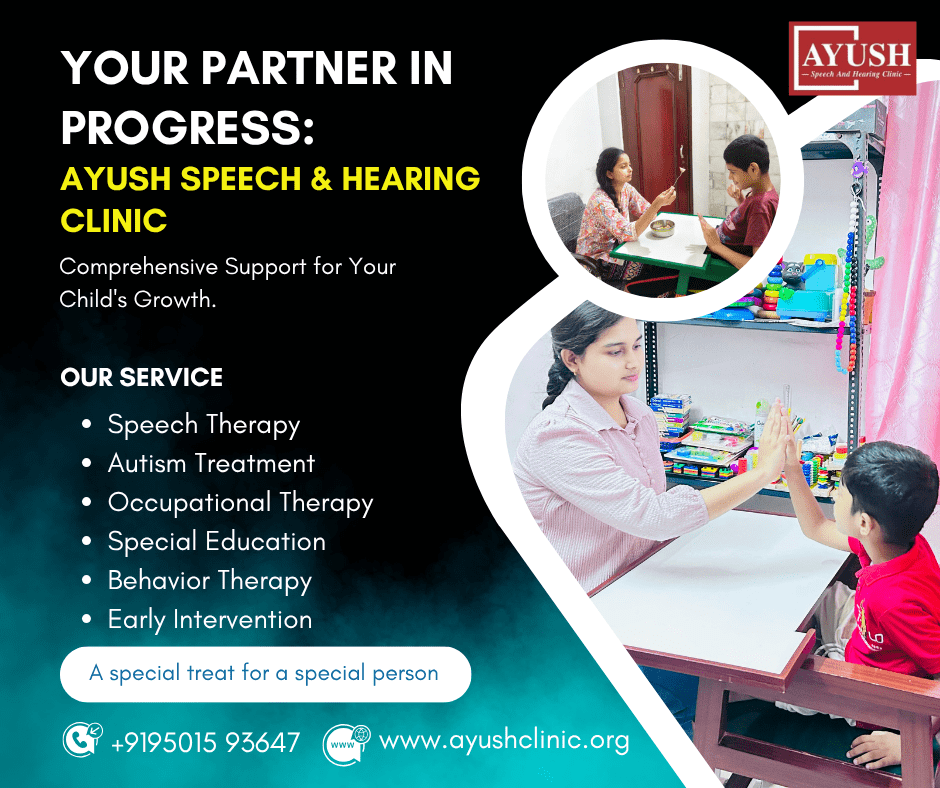
We offer a wide range of specialized services, all under one roof, designed to address the unique needs of each child and family:
- Speech Therapy: Our expert Speech-Language Pathologists use engaging, play-based methods to help children with articulation, language understanding, vocabulary, sentence structure, and social communication.
- Autism Treatment: We provide holistic support for children with Autism Spectrum Disorder, focusing on communication, social skills, and behavioral management.
- Occupational Therapy: Our occupational therapists help children develop crucial fine and gross motor skills, sensory processing, and self-care abilities, which often impact overall development and communication.
- ABA (Applied Behavior Analysis): A highly effective, evidence-based therapy that helps children develop new skills and reduce challenging behaviors.
- CBT (Cognitive Behavioral Therapy): For older children, CBT can help address underlying anxieties or thought patterns that may impact communication and social interaction.
- Special Education: Tailored educational programs designed to meet individual learning needs and provide academic support.
- Behavior Therapy: Strategies to understand and manage challenging behaviors, creating a positive environment for learning and growth.
- Early Intervention: This is our core philosophy. We believe that identifying and addressing delays as early as possible yields the most significant and lasting results for a child’s development.
We are proud of our holistic approach, where different therapies work together to support your child’s complete growth.
Don’t Wait – Empower Your Child’s Future Today!
If you’ve read through this and feel that voice inside telling you to act, listen to it. Early intervention is the most powerful gift you can give your child. Imagine them confidently expressing themselves, connecting with others, and thriving in every aspect of life. This future is within reach.
Take the first brave step. Don’t let another day pass wondering what to do.
Call Ayush Speech and Hearing Clinic today for a comprehensive evaluation. Our compassionate team is ready to listen, understand, and create a personalized plan for your child’s communication success.
Visit our website: https://ayushclinic.org/
Find your nearest branch: We have 20 locations across Punjab, Dhanbad, and Kolkata.
Find details here: https://ayushclinic.org/branches/
Or, simply call us: +9195015 93647
Your child’s voice is waiting to be heard. Let us help them find it.
Our Other Blogs
Every Moment Counts: Why Early Intervention for Autism Builds a Brighter Future
Sensory Behaviours in Children – कैसे संभालें Hitting, Pinching और Slapping जैसी आदतें?
इंटेलेक्चुअल डिसेबिलिटी (Intellectual Disability) क्या है: लक्षण, कारण और इलाज | पैरेंट्स गाइड 2025