
Does your child cover their ears when a mixer runs, refuse to wear certain clothes, or jump around all the time? Many parents face this, but often don’t know why. The reason may be sensory processing difficulties—when a child’s brain struggles to handle information from their senses.
The good news? With the right help, children can learn to manage this. That’s where Sensory Integration Therapy comes in. It’s a fun, play-based therapy that uses swings, trampolines, pressure hugs, and calming activities to help kids feel more balanced and confident.
In this guide, we’ll explain what Sensory Integration Therapy is, how it works, its benefits, and how parents can support their child at home.
What Is Sensory Integration Therapy?
Imagine your child’s brain as a busy railway station. Trains (sights, sounds, touches, movements) are arriving from all directions. But if the signal system doesn’t work, trains crash, get delayed, or make chaos.
For a child with sensory processing difficulties, their brain works like that faulty signal. They may:
- Cry at loud sounds
- Avoid hugs or touches
- Struggle to sit still in class
- Become restless or anxious in busy places
Sensory Integration Therapy acts like the traffic controller. It teaches the brain how to organize and manage these signals smoothly. Slowly, your child learns to feel calmer, respond better, and enjoy daily life.
Does My Child Need Sensory Integration Therapy? 6 Warning Signs Parents Should Know
If you notice these challenges, it may be time to consult an occupational therapist:
- Trouble focusing in school
- Getting upset by loud sounds, textures, or lights
- Difficulty making friends or playing with peers
- Avoiding hugs or physical contact
- Trouble sleeping
- Being too restless, clumsy, or hyperactive
Early help can make a big difference. The earlier therapy starts, the easier it is for the child to adapt and grow.
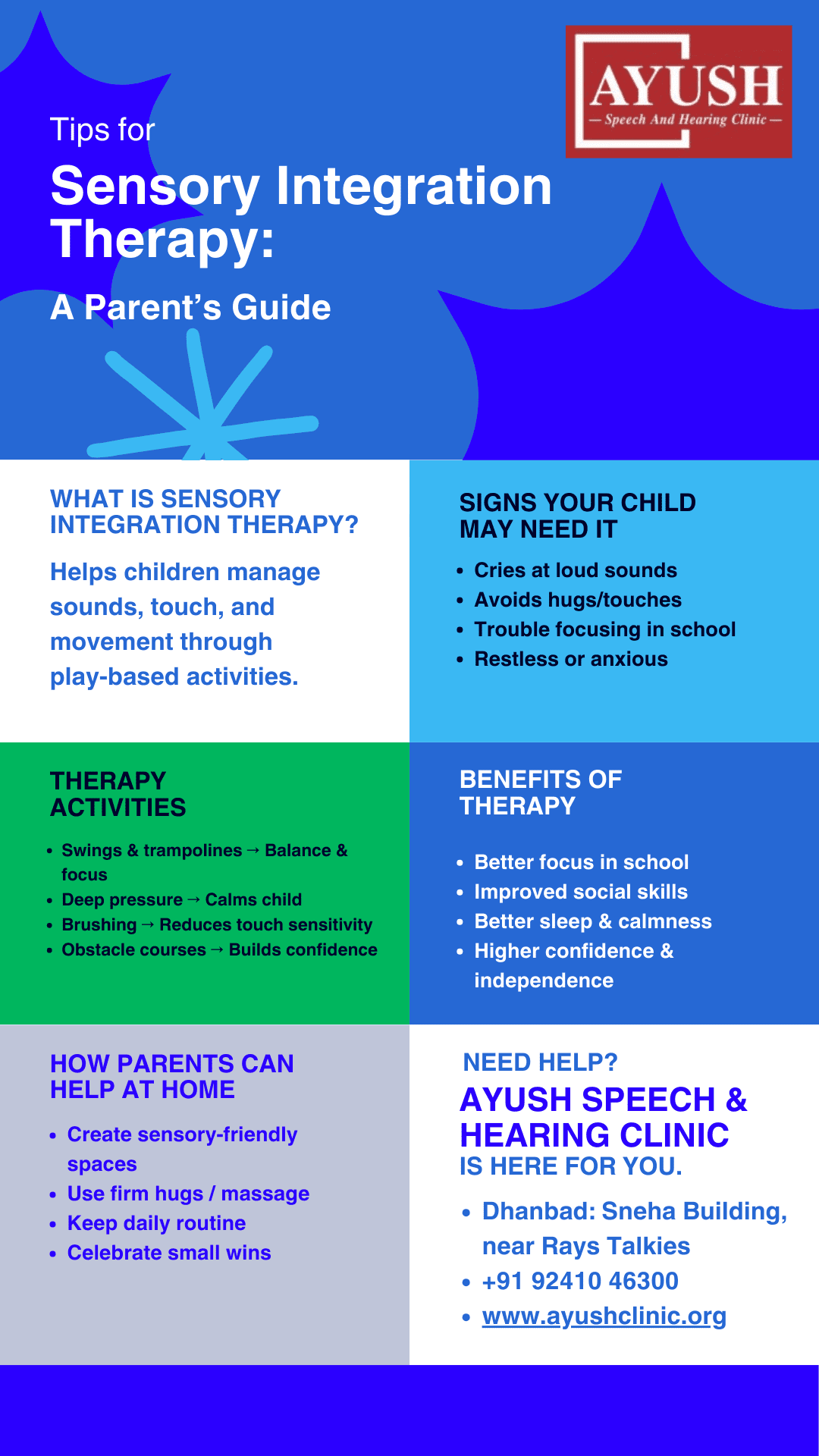
Activities in Sensory Integration Therapy
Therapy is not about lectures or medicine. It’s about play-based learning. Kids often think it’s just fun time, but each activity is carefully planned by an occupational therapist.
Some common activities include:
- Swings and trampolines → help children improve balance, movement, and focus.
- Deep pressure (weighted vests, firm hugs, bean bag squeezes) → calms an overactive child, makes them feel safe.
- Brushing (arms, legs, or back) → reduces sensitivity to touch.
- Slides and obstacle courses → build coordination and confidence.
- Quiet play areas with textures, lights, or calming music → improve comfort in different environments.
Every child’s program is customized. What works for one may not work for another—and that’s the beauty of Sensory Integration Therapy.
6 Life-Changing Benefits of Sensory Integration Therapy for Children
Parents often ask: “Does this really work?” The answer is yes—when done consistently and with the right guidance.
Here are the key benefits:
- Improved focus in school – children sit longer, pay attention, and follow instructions.
- Better social skills – they play with friends, share toys, and join group activities.
- Increased confidence – success in small activities builds self-esteem.
- Improved sleep – calming activities reduce restlessness at night.
- Reduced stress and anxiety – children feel more secure in daily life.
- More independence – they learn to manage clothes, food, and play more easily.
One parent in our Kolkata center told us her son used to cover his ears at school bells. After two months of therapy, he now happily joins his classmates in the playground.
Who Provides Sensory Integration Therapy?
Occupational therapists are like guides who help children build everyday life skills—whether it’s playing, dressing, or learning. They use fun activities to gently train the brain.
For children, occupational therapists use a mix of physical play, structured activities, and home exercises. Parents are also taught simple activities to continue at home.
How Parents Can Support at Home
Therapy works best when parents join the journey. Here are simple ways you can help:
- Create a sensory-friendly space
- Use soft lights, quiet corners, or weighted blankets.
- Include play in daily routine
- Swings, jumping, cycling, and running help with sensory balance.
- Encourage touch with variety
- Sand play, clay, water games, and textured toys build tolerance.
- Use deep pressure
- Firm hugs, massage, or wrapping in a blanket helps calm a restless child.
- Keep a routine
- Fixed times for eating, playing, and sleeping reduce anxiety.
- Celebrate small wins
- A clap, hug, or high-five motivates your child to keep trying.
Remember: Your patience and support are as important as therapy itself.
Sensory Integration Therapy for Adults
Though it’s most common in children, adults with sensory challenges can also benefit. For example, adults who get overwhelmed in crowded places, struggle with touch sensitivity, or find it hard to focus at work can use therapy to manage better. Occupational therapists modify activities based on age and needs.
When to See a Professional
If your child’s sensory challenges affect their daily life—school, sleep, play, or friendships—it’s time to consult an occupational therapist. Don’t wait and hope it will go away. Early support is always better.
Conclusion
Sensory struggles can make a child’s world confusing, stressful, and overwhelming. But with Sensory Integration Therapy, children can learn to handle sights, sounds, and touches in a calmer way.
It’s not just therapy, its play, confidence-building, and life skills rolled into one. And with your support as a parent, the progress can be life-changing.
So if you’ve ever wondered, “Why is my child reacting like this?”—know that there’s hope, and help is available.
Your child is not ‘too sensitive’ or ‘difficult’—their brain just experiences the world differently. With the right therapy and your love, they can feel safe, confident, and truly happy in their little world.
Does your child struggle with sounds, touch, or restless behavior?”
You’ve just read how Sensory Integration Therapy can help children feel calmer, focus better, and enjoy everyday life. But reading is only the first step—the real change happens when therapy begins.
At Ayush Speech and Hearing Clinic, we specialize in helping children with:
✔ Sensory Processing Difficulties
✔ Autism Treatment & Early Intervention
✔ Speech Therapy & Language Development
✔ Occupational Therapy
✔ ABA / CBT & Special Education
With 20+ branches across India—including Amritsar, Ludhiana, Jalandhar, Patiala, Dhanbad, and Kolkata—we are closer to you than you think. Our expert team of therapists has helped thousands of children unlock their true potential through structured, play-based therapy.
Visit Our Dhanbad Clinic:
Ayush Speech and Hearing Clinic
Gate no.2, Sneha Building, near Rays Talkies, Naya Bazar, Pandey Muhalla, Dhanbad, Jharkhand 826001
Call Us Today: +91 92410 46300
Explore More: www.ayushclinic.org
Every Moment Counts: Why Early Intervention for Autism Builds a Brighter Future
Sensory Behaviours in Children – कैसे संभालें Hitting, Pinching और Slapping जैसी आदतें?
इंटेलेक्चुअल डिसेबिलिटी (Intellectual Disability) क्या है: लक्षण, कारण और इलाज | पैरेंट्स गाइड 2025